SEDL Home
Advancing Research, Improving Education
SEDL's Reading Resources
Cognitive Framework of Reading Reading Assessment Database Short Papers - Topics in Early Reading Coherence Reading First Links
List of Short Papers


Additional Reading Articles are available in SEDL Letter, SEDL's magazine.


cover art
Reaching Our Reading Goals
*This edition of SEDL Letter won the Platinum award in the 2005 MarCom Creative Awards.


cover art
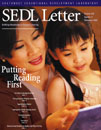
Putting Reading First
*This edition of SEDL Letter won first place in the nationwide EdPress 2003 Distiguished Achievement Award.

Short Papers - Topics in Early Reading Coherence

Ten Myths of Reading Instruction

There are many beliefs and a great deal of dogma associated with reading acquisition, and people are often reluctant to let go of their beliefs despite contradictory research evidence. Here are 10 of the most popular and most potentially pernicious myths that influence reading education.

 
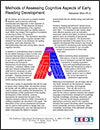
Methods of Assessing Cognitive Aspects of Early Reading Development ( PDF version)

It is important that children's early reading abilities be assessed frequently, and that assessment information should be used to inform and modify the instruction that each child receives. This article was written to help teachers better understand what needs to be tested and how to go about testing the essential areas that are so important to reading development.

 
Making Sense of Reading ( PDF version)

Principals and administrators know that quick fixes are not likely to help when children are not learning to read. The root of the problem is often related to what teachers know and understand about children's learning to read. Many teachers do not have a conceptual understanding of reading. In addition, teachers often do not know what parts of their reading instruction work or do not work, and as a result, why their students' test performances are high or low.

 
What Does a Balanced Literacy Approach Mean? ( PDF version)

The Great Debate about reading has always centered around whether teachers should focus on Phonics instruction or Whole Language instruction when teaching children to read. Now a new philosophy, Balanced Reading, is gaining popular acceptance as a compromise.

 
Reading and the Three Cueing Systems ( PDF version)

The Three Cueing Systems model of word recognition is one of the most widely accepted and least supported models of word recognition. This potentially pernicious model is analogous to a puzzle in which all of the right pieces are arranged incorrectly.

 
Understanding the Brain and Reading ( PDF version)

What is happening in the brain when a person reads? There is still a great deal about the function and activity of the brain that we do not understand yet, but we have gained a few insights into the workings of the brain during reading, and these insights do have some implications for reading assessment and reading instruction.

 
What is Reading? - Decoding and the Jabberwocky's Song ( PDF version)

What is "reading?" The term is used generically and almost arbitrarily to describe many different behaviors by both man and machine, so what do we mean when we talk about "the ability to read?" Arguably, we need to define our terms more clearly.


Regular and Exception Words ( PDF version)
Teachers of young readers simultaneously need to teach children to decode words by sounding them out, and at the same time, they need to explicitly teach children the correct pronunciation for words that can not be accurately sounded out. To help teachers, we've compiled a database of what are commonly known as exception words or irregular words -- words that are not spelled the way they sound.

 
Reading by Sight ( PDF version)

What is a "sight word"? Some say it is a word that a child has memorized as a whole (without learning to decode the word), some say it is any word that can not be "sounded out." Others argue that a sight word is a word that a child no longer struggles to sound out. Taking the first definition as the most widely accepted definition, the question then arises, should we focus on "sight words" when teaching children to read? Is it beneficial for children to memorize words as wholes when the goal of reading is to learn to break words down into parts?

 
Phonics Rules ( PDF version)

Children clearly need to be explicitly taught to sound out words -- to develop what some call "word attack" skills. That much is not in question -- what is in question is the best approach for teaching children the system that is used for decoding English text.

 
The Phive Phones of Reading ( PDF version)

Who can understand all the jargon that's being tossed around in education these days? Consider all the similar terms that have to do with the sounds of spoken words -- phonics, phonetic spelling, phoneme awareness, phonological awareness, and phonology - all of them share the same "phon" root, so they are easy to confuse, but they are definitely different, and each, in its way, is very important in reading education.

 
Reading Across the Southwest Region

Here is a summary of initiatives and legislation in place or under consideration in Arkansas, Louisiana, New Mexico, Oklahoma, and Texas.

 
Southwest Region Statewide K-2 Reading Assessments

Many states are implementing legislation requiring early assessment of reading in grades K-2. This paper discusses state requirements and recommendations for reading assessment in states in the Southwest Region (AR, LA, NM, OK, and TX).

Join Our Mailing List

If you would like to stay informed about changes to SEDL's reading resources, you can join our mailing list. Information you provide here is kept confidential.
Click to view SEDL's Professional Development Session:
What Does It Mean to Teach Reading Explicitly?
Click to view SEDL's Professional Development Session:
Adolescent Literacy:  How to Access and Comprehend Text
Copyright ©2009 SEDL
About SEDL | Contact SEDL | Support SEDL | Terms of Use