The Reading Acquisition Framework - An Overview by Wesley A. Hoover and Philip B. Gough
From
the cognitive perspective of learning to read, reading comprehension
(or, simply, reading) is the ability to construct linguistic meaning
from written representations of language. This ability is based
upon two equally important competencies. One is language comprehension–the
ability to construct meaning from spoken representations of language;
the second is decoding–the ability to recognize written representations
of words. These two main foundations of reading are represented
by the two supporting legs in the graphic depiction of this cognitive
framework.
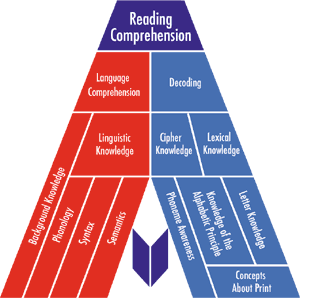
Both
of these are complex abilities themselves, each based on other abilities,
as shown in the graphic. In this simple view of reading, both language
comprehension and decoding are necessary for reading comprehension
success. Neither is sufficient in itself. On the one hand, being
fully competent in a language but having no ability to recognize
its written words will not allow successful reading comprehension.
On the other hand, neither will having the ability to recognize
the written words of a language but not having the ability to understand
their meaning. In this view, the only route to successful reading
comprehension is through success at both language comprehension
and decoding. Weakness in either ability will result in weak reading
comprehension. Thus, knowing where obstacles to reading and its
acquisition exist requires assessing both language comprehension
and decoding abilities. Let's consider the abilities needed for
success in these two broad domains.
|

|
 |
 |
| |
The ability to read and understand a passage
of text depends upon two equally important skills:
- the ability to decode the words in the text
- the ability to understand the language the text is written
in
Children who do not have problems understanding
spoken language and who are able to fluently and easily decode
text do not have problems with reading comprehension. On the
other side of the coin, children who do have problems with
reading comprehension always have problems with either the
ability to understand language or the ability to decode written
words (or both; see sidebar).
There are three basic types of reading disorder
(ranked in order from least common to most common):
- Hyperlexia, which is characterized by the ability to rapidly
and easily decode text without understanding what is being
read (very rare).
- True dyslexia, or the ability to understand spoken language
but an inability to decode text (less rare).
Garden-variety reading disorder, which characteristically
involves a difficulty decoding text and a difficulty
understanding spoken language (relatively common).
|
|
 |
|
 |

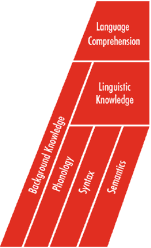
The ability to construct the meaning of spoken language, or language
comprehension, requires a complex mix of different abilities, each
somewhat dependent on the other. However, two large domains of knowledge
are required for success. The first is linguistic knowledge, or
knowledge of the formal structures of a language. The second is
background knowledge, or knowledge of the world, which includes
the content and procedural knowledge acquired through interactions
with the surrounding environment. The combination of these two allows
us to make inferences from language. We can go beyond the literal
interpretation allowed by competence in the language, to inferences
from language that are built in combination with our knowledge of
the world. For example, entering your house on a cold winter day
and being told that the door is still open allows you to infer that
the speaker would like you to close it! The following text more
fully describes each of the two domains that underlie such comprehension.

Knowledge that underlies competence in a language can be divided
into three large domains. Phonology describes knowledge of the sound
structure of a language and of the basic elements that convey differences
in meaning, including their internal structure and their relationships
to each other. The child who cannot produce or hear the sounds that
distinguish one word from another will not be able to use language
effectively to communicate. Semantics deals with the meaning components
of language, both at the level of individual units (words and their
meaningful parts, or morphemes, such as "pre" in the word "preview")
and at the higher levels that combine these units (morphemes into
words, words into sentences, sentences into discourse). Thus, part
of linguistic knowledge involves learning the individual meanings
of words (or vocabulary) as well as the meaning of larger segments–sentences
and discourse structures (e.g., narratives and expositions). Syntax
constitutes the rules of language that specify how to combine different
classes of words (e.g., nouns, verbs, adjectives) to form sentences.
In short, syntax defines the structural relationship between the
sounds of a language (phonological combinations) and the meaning
of those combinations.

Knowing how the everyday world works, both in terms of content
and procedures, is a crucial component of language comprehension.
While linguistic knowledge represents the rules for how language
operates, background knowledge represents the substance on which
language operates. In communicating through language, successful
comprehension requires both the ability to use the language and
knowledge of the substance to be communicated. One way to describe
such knowledge is in terms of schemas–structures that represent
our understandings (e.g., of events and their relationships). Schemas
can represent fairly common knowledge (e.g., dining in a restaurant,
including being seated, ordering, being served, eating, and finally
paying a bill) or fairly esoteric knowledge (e.g., how computer
programs complete searches for information). If you have a well-developed
schema in a particular domain of knowledge, then understanding a
conversation relevant to that domain is much easier because you
already have a meaningful structure in place for interpreting the
conversation. Now let’s consider the other major component
of reading comprehension.

Alphabetic languages are those whose writing systems relate the
written and spoken form of words systematically. In English, both
systematic and unsystematic (or idiosyncratic) relationships exist,
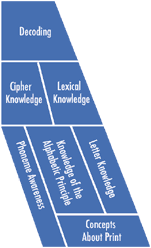
and the successful reader must master both. Decoding is the ability
to recognize both types of relationships between written and spoken
words. And both of these are necessary for successful word recognition.
Knowing these systematic relationships allows us to read many new
words that we’ve never before encountered in written form.
Knowing the exceptions allows us to access the meaning of a known
word whose spelling violates the systematic relationships.

The systematic relationships between written and spoken words are
those that consistently relate the units of the written word (the
letters of the alphabet) and the units of the spoken word (not the
sounds themselves, but the abstract units–the phonemes–that
underlie the sounds). Knowledge of these relationships is known
as cipher knowledge. As an example, a word like "pad" exemplifies
a systematic relationship between three letters and three phonemes.
But "colonel" represents a systematic relationship between only
its initial and latter units, not its medial ones (contrast this
with the systematic relationship in "colon"). If a child learns
the systematic relationships, she can recognize words she has never
before encountered in print, but whose meaning she already knows
from the course of language acquisition. This is the typical situation
for the child learning to read.

Beyond the systematic relationships captured in cipher knowledge
are the exceptions–those instances where the relationships
between the units of the spoken and written word are unique and
do not follow a systematic pattern. Knowledge of these exceptions,
or lexical knowledge, is necessary for a child to be able to access
the meaning of words she knows (e.g., "stomach") but that do not
entirely follow the patterns captured in her cipher knowledge.

To learn the two types of relationships upon which decoding ability
depends, a number of other abilities are needed.

The first is letter knowledge, or the ability to recognize and
manipulate the units of the writing system. In English, these units
are the letters of the alphabet. Knowing the names of letters is
not what is crucial here (although most children learn to distinguish
letters by learning letter names); rather, what is important is
being able to reliably recognize each of the letters.

In a similar fashion, one must be consciously able to recognize
and manipulate the units of the spoken word–the phonemes that
underlie each word. The knowledge behind this ability must be explicit,
not implicit. That is, any child who knows a language can implicitly
recognize and manipulate the sounds of the language that mark differences
in meaning between words (e.g., "bat" and "bag" as different words
with different meanings). However, knowing explicitly that this
distinction in meaning is carried by a particular unit in a particular
location (i.e., by the last unit in the preceding example) does
not come automatically with learning the language. It is something
that in most cases must be taught in order to be learned. This knowledge
is phoneme awareness: the conscious knowledge that words are built
from a discrete set of abstract units, or phonemes, coupled with
the conscious ability to manipulate these units.

Finally, it is not enough to simply know and be able to manipulate
the units of the written and spoken word. To master both the cipher
and lexical knowledge components of decoding, one must understand
that there is, in general, a systematic relationship between these
units, and that discerning the particular relationship is what is
required to master decoding. Without the intent to discover this
relationship, the would-be reader will not understand the task before
her. This intent is captured in knowledge of the alphabetic principle:
knowing that a systematic relationship exists between the internal
structure of written and spoken words, and that the task of learning
to recognize individual words requires discovering this relationship.

Finally, the basis for knowledge of letters and the alphabetic
principle is knowledge of the mechanics of the printed word, or
concepts about print. This includes knowing that printed text carries
a linguistic meaning, that there is a correspondence between printed
and spoken words, and that text in English runs left-to-right and
top-to-bottom on a page.
|