An Infrastructure for School Improvement
The power and effectiveness of professional learning communities come from their position as communities of continuous inquiry and improvement. In order to help low-performing schools become communities of continuous inquiry and improvement, one must first acknowledge and understand the issues that are affecting those schools’ efforts to make improvements. New programs or practices that do not acknowledge and address the underlying issues will merely scratch the surface, and are unlikely to be sustainable over time to benefit learning.
Issues Impacting School Reform

During the last two years, SEDL has engaged in a project that examined how schools undertaking comprehensive reform experienced these improvement efforts. Collectively, the sites displayed characteristics that are symptomatic of the challenges in public education across the nation—achievement scores were consistently low or falling, students were unhappy and/or unmotivated, parents were ignored, community members were disengaged, and school staff did not believe they could affect student learning.
The objective of this work was to engage in partnerships with low-performing schools and to assist them in undertaking comprehensive school reform efforts by providing resources, materials, and group facilitation. While SEDL staff did not go into the schools to create professional learning communities, each SEDL staff member was strongly committed to the professional learning community philosophy and its infrastructure to support school improvement efforts. The value of professional learning communities was reinforced when SEDL staff reviewed the first year’s work at each site and identified five core issues that were significantly affecting schools’ past and present efforts at improvement: organizational structures, focus of improvement work, personal and social dynamics, contextual influences, and leadership.
There are distinct parallels between the issues that low-performing schools are struggling with and the dimensions that support a strong professional learning community in higher-performing schools.
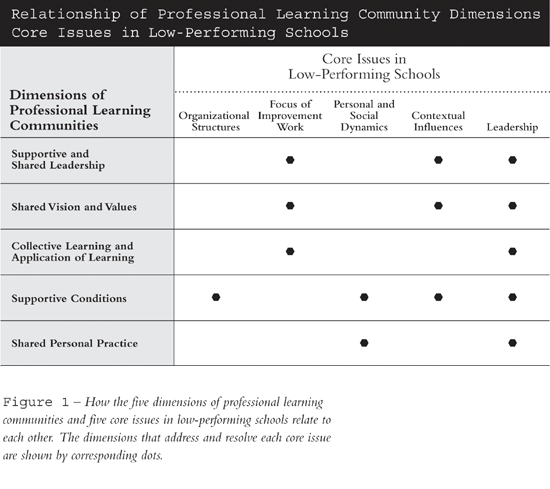
Figure 1 displays how the two frameworks (five core issues in low-performing schools and five dimensions of professional learning communities) relate to each other.
The five dimensions of the professional learning community infrastructure support school improvement efforts while the five core issues constitute barriers to the improvement process. In reviewing these findings, SEDL staff confirmed the importance of a supportive professional learning community infrastructure. Low-performing schools are weak in the identified factors where professional learning communities are strong. The following is a brief clarification of each core issue (Morrissey, 2000), and its parallel(s) within professional learning communities.
Organizational Structures. With appropriate structures and processes in place, effective schools run efficiently. In the study schools, many of the necessary organizational supports were lacking, and the result was disorganization, unclear directions and processes, few to no avenues for problem solving or collaboration among staff, and frustrated teachers. Finding time for staff to come together for learning, problem solving or decision making was difficult at these sites. Communication among school staff, district staff, and community members was weak, and organizational processes necessary to run the school efficiently were lacking, as well. A disconnect between purpose, intent, and action resulted at each of the sites.
Within professional learning communities, Supportive Conditions are provided for staff to go about their daily work and engage in learning together; the physical conditions of a school are attended to. Time is provided for staff to meet regularly in large and small groups. Acknowledging that finding such time is a critical component to their success, staff value the time provided by engaging in substantive work and learning together. Communication and organizational processes run smoothly within the administrative office and among the school staff. Weekly or daily bulletins are issued, informing staff of events, decisions, and questions. Communication structures with the central office are clearly established, and parents are regularly informed of school events via newsletters and phone calls.
Focus of Improvement Work. Maintaining an undeviating focus on students is central to identifying and articulating purposeful intent for any school’s reform work. Such a focus was lacking at the comprehensive reform sites. Often, small groups or individuals appeared to have a grasp of the overall intent of improvement work at the sites, but staff-wide common focus and effort were not apparent. Also significant were the low levels of teacher empowerment found within these schools—teachers’ ability and willingness to access information, identify needs and potential solutions, and engage in self-study were limited. The result was inconsistency of purpose, mixed messages, and inefficient implementation of instructional strategies across the sites. Staff were unclear about the usefulness of examining student achievement data, did not participate in collaborative problem solving, and held low expectations with regard to their students’ achievement potential. These schools did not seek information by tapping into research or literature regarding best practices, and they made little use of available technical assistance providers. In addition, each school site struggled with conflict among the staff and had limited resolution strategies in place.
The focus of school improvement work within professional learning communities is supported and maintained by three dimensions, Supportive and Shared Leadership, Shared Values and Vision, and Collective Learning and Application of Learning. In schools with the professional learning community infrastructure, the values and vision are clearly established and articulated among staff. The shared vision is used as a lens for all improvement initiatives, and it provides the foundation for the work the staff engages in together. Data are analyzed with the focus in mind, and current research and literature are examined and discussed among staff, in order to identify best practice for their school. This collective learning provides opportunities for professional staff to discuss the needs of their students and engage in study to inform their teaching practices in addressing those needs. Supportive and Shared Leadership plays a part in maintaining the focus by using the vision with the staff to guide decision making. Campus principals, through their words and actions, also model the vision on a daily basis for staff, students and parents/community.
Personal and Social Dynamics. A culture of trust, mutual respect and regard within relationships, and collective engagement of staff and administrators are components of effective schools. However, the personal and social dynamics at the study sites varied substantially. At some schools, the staff were open with one another, and a certain level of trust had been established over time. At other sites, however, the culture was distrustful—or at best, unsupportive—of staff-wide openness and respect. At each site there was the need to establish norms with the group about working together and set some precedents regarding group involvement. There were very few opportunities, either within school or outside of it, for staff to do fun things together, learn together, laugh together, or just get to know each other. Little or no work had been done with school staffs to acknowledge and value the differences in culture, experience, and expertise that they brought to the school environment. Due to the limited interactions among the staff, opportunities for building trust and collegial growth were hindered.
Again, the Supportive Conditions dimension in professional learning communities addresses these issues. The people capacities, which include positive attitudes and relationships, are valued and nurtured among staff. Norms that support the vision for the school are discussed and maintained by all professional staff, and efforts are made to keep communications clear, respectful, and caring. Professional learning communities appear to function more as “families,” engaging in problem solving and conflict resolution when needed. Another component of professional learning communities is Shared Personal Practice, which requires openness, trust, and respect among colleagues. Once positive relationships have been established among staff members, the sharing of teaching methods and strategies becomes a trusted and valued practice within the school community.
Contextual Influences. A school does not operate separate or apart from surrounding entities.
School contextual factors include: maintenance of the physical plant; relationships among students and staff; issues of culture, race, and education; and low expectations for staff as learners.
Community contextual factors include: negative media; concerned board members; disputes between communities; staff discomfort in working with parents and community members;
District contextual factors include: numerous requests of schools with regard to policies; administrivia; organized systems for maintaining data, resources/materials, and record keeping.
State-level contextual factors include: communication of policies, adoptions, and mandates that have significant impact on the operation of schools. In the case of these low-performing schools, each set of contextual factors deeply affected progress in school improvement.
Within professional learning community schools, the Shared Vision and Values and Supportive Conditions that are in place temper the various contextual influences. School conditions for learning are reflected in the shared vision among staff and students, maintaining a pleasant teaching and learning environment, with positive relationships with students and high expectations for all. Communication lines between the school and the community, as well as the district office, are open as the result of positive working relationships. In an aspect of the Supportive and Shared Leadership dimension, requirements of the state are communicated to staff via the district office and the principal, who stays current on changes in policy and regulations.
Leadership. The most critical of the themes emerging from the first year of work was the leadership capacity of the principals, which had significant impact and influence on the other four core issues. Without identifying a shared focus for improvement, administrators could not guide their staff in developing and articulating a collective vision for their students or their school. This lack of clarity made it difficult for the administrators to model the vision or mental image of improvement through their actions with staff, students, parents, and community. The expectations of administrators for their staff and students tended to be based on historical norms and relationships, and high expectations were rarely modeled for staff or students. The absence of decision-making structures prevented teachers from being involved in long-range planning and resulted in unilateral decisions made by the administrator. A lack of organizational systems was apparent in planning efforts, in meetings, and in daily work. Systems for communication among staff and between school and home were also inadequate. Too often, administrators also left conflict to resolve itself, a situation that then became detrimental to the school and/or the staff.
Supportive and Shared Leadership in professional learning communities looks much different than in low-performing schools. Using their Shared Values and Vision as a lens, administrators guide the school with the participation of their professional teaching staff. Expectations are high for all staff and students, and the principal models those expectations daily in words and actions. Decision-making structures are developed and put into place by the principal to facilitate the involvement of teachers in decision responsibilities. The administrator is primarily responsible for developing the Supportive Conditions within their school. In designing efficient systems for operation, communication, and learning, the principal influences the physical conditions within a school. In providing opportunities for staff to learn together, to have fun together, and to work together, the principal is developing the people capacities on the campus. The actions of leadership pave the way for Collective Learning and Application of Learning and Shared Personal Practice to occur within a professional learning community school.
It is interesting to note the parallels between the core issues affecting comprehensive reform at the low-performing schools, and the dimensions that support and nurture professional learning communities. Not only did the comprehensive school reform project provide evidence of the lack of development of school improvement infrastructures in low-performing schools but it also strengthened the argument for developing professional learning communities in all schools.
Research shows that low-performing schools can overcome the implementation problems that accompany reform efforts, and increase student achievement, when the staff and school are organized as a professional learning community (Lee, Smith & Croninger, 1995; Newmann & Wehlage, 1995; Reyes, Scribner & Paredes Scribner, 1999). In such cases, school staffs have learned to develop their own capacity in order to produce improved student outcomes from year to year. It is clear that the development of a professional learning community—an environment that nurtures and supports learning together, trust, respect, common goals, and high expectations for staff and students—can address the issues that many educators are struggling with in their schools today.
Guiding Questions for Learning
A school that experiences consistently high student achievement scores is not necessarily a school that exemplifies a professional learning community. Frequently, such a school is one in which student demographics or needs have not changed significantly over time and school staff have found a comfortable place in their teaching of the basics as assessed by achievement tests. If, however, this school staff is expected to address higher curriculum standards, if they are required to provide higher-quality intellectual learning tasks for their students, or if their community experiences a significant change in student population or demographics (not uncommon in our ever-changing society), they are often ill prepared to address their students’ academic needs.
School staffs that work together as professional learning communities reach and maintain high achievement scores while engaging in continuous inquiry to address the diverse needs of students (Newmann & Wehlage, 1995). In the event of a significant change in this type of school, staff are prepared to accommodate the learning needs of their students and will have a structure in place to immediately address new situations. In fact, it is likely that such a staff will have been preparing for changes in advance, predicting the upcoming needs of their learners, and learning ways of revising their methods in preparation for change.
At a point when schools are increasingly expected to compensate for changes in family structures, shifting trends in popular culture and commercialism, poverty, violence, child abuse, substance abuse, teen pregnancy, and general social upheaval, it is clear that support systems for educators are critical. The ongoing process of inquiry and improvement within a professional learning community that is centered around meeting the needs of students nurtures the growth and change necessary for improving the effectiveness of the teaching and administrative staff. All members of the community are invested in helping all students achieve high standards of learning. It is with this focus that schools formerly struggling with such demands have been lifting themselves “up by the bootstraps” and making improvements that knock them off the lists of low-performing schools. Research continues to show that professional learning communities provide the structures and assistance essential to educators who are addressing the increasingly diverse needs of their students (Reyes, Scribner, & Paredes Scribner, 1999).
What the research lacks, however, is knowledge regarding the manifestation of professional learning community characteristics. What happens, or what is done, to turn a low-performing school into one that operates as a professional learning community, that then exceeds former expectations regarding student achievement and staff interaction? Are there key elements in schools that have made this transformation? If so, what are they? What processes or strategies are put in place to assist the growth and change of school staffs’ professional practices into a community arrangement? What motivates school administrators and school staffs to examine their actions collectively and deeply and make significant turnarounds in their practice? What barriers get in the way of creating professional learning communities, and how do school staffs steer around them successfully? What elements of support are necessary for school staffs while they are undergoing the process of change to professional learning communities? Can this learning be taught, or is it simply the result of keen awareness, intrinsic motivation, and the resulting actions on the part of school staffs and/or administrators? What, if any, of this information can be replicated in schools across the country?
While the terms used to describe professional learning communities vary in the research literature, the dimensions of such communities are consistently thematic and are similar to the five identified by Hord (1997). The Southwest Educational Development Laboratory (SEDL) has been diligently focused on adding to that work. To that end, SEDL staff developed a new research agenda, with the intent not only to confirm the previously identified dimensions of professional learning communities but also to begin identifying actions taken by administrators, teaching staff, and external change facilitators who are attempting to develop a professional learning community.
The remaining text of this document is the initial result of that work-—which acknowledges and begins to answer the “How do you get there?” question that has been asked repeatedly by administrators and teachers when SEDL staff have shared research about professional learning communities. Our speculation is that schools continue to struggle with improvement issues because there is a significant disconnect between “what the research says” and the school’s ability to put that research into practice while simultaneously balancing the daily struggles and dramas associated with the highly complex organizations that we call schools. Our experience suggests that research-proven practices can be more effectively transferred to the classroom when teachers have the support of their professional colleagues as they learn about and implement new programs and processes. This document will share what SEDL staff are learning about the actions of educators who are developing these communities of professional learners—how they’ve gotten there, or how they are presently working to get there.
Next Page: What We Are Learning