Connecting Kids to Mathematics, Science, and Technology
According to the National Science Foundation, underrepresented minorities made up 25% of the U.S. population but only around 10% of all scientists and engineers in business and industry in 2006 (NSF, 2009). While minority representation has increased, there is room for improvement. The place to begin is in the classroom, where students can be inspired by teachers who spark their interest in science and math, and who are comfortable with project- and inquiry-based teaching strategies.
This spring, teachers in Austin, Texas, began discovering new ways to use technology to teach their students math and science. SEDL is leading this discovery through the Connecting Kids to Mathematics, Science, and Technology project, which is funded by the Educational Foundation of America and the KDK-Harman Foundation. Specialists from SEDL are working with teachers from Austin Independent School District to pilot a professional development process for integrating math, science, and technology instruction. The project is grounded in scientifically based research, particularly that reported in the Institute of Education Sciences practice guide Encouraging Girls in Math and Science (see "Research Update.")
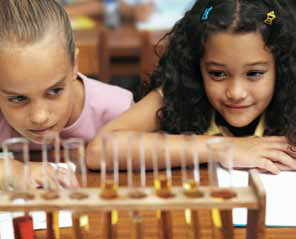
The Connecting Kids project will help teachers learn to provide rich and challenging hands-on experiences in math and science.
Forty teachers from the participating schools— Norman Elementary, Overton Elementary, Garcia Middle School, and the Ann Richards School for Young Women Leaders—are taking part in the project. All of the schools are high-need, high-minority upper-elementary and middle schools. "Adolescence is often a turning point for many students," says Haidee Williams, a project director who leads science enrichment activities. "They begin opting out of math and science classes, thereby limiting education and career opportunities in these fields. With this project, we hope to keep more kids interested in math and science."
The Connecting Kids project will help teachers learn to provide rich and challenging hands-on experiences in math and science and integrate the two content areas. Professional development sessions will also show teachers how they can collaborate on planning and executing integrated math and science lessons. The collaboration will not be limited to teachers; students will have access to a protected social networking site so they can collaborate on projects and share problems and solutions. Concepción Molina, a SEDL program associate who is leading math work on the project, wants to teach a new generation of students that they can excel at—and enjoy—math. "It is imperative that students truly believe that success in mathematics is based on effort and persistence, not on ability," he explains.
Teachers are also learning to incorporate technology tools such as digital cameras, digital microscopes, graphing calculators, and portable GPS units to boost students’ engagement and achievement. "Students bring a range of experiences to the classroom," says SEDL project director Danny Martinez, who leads the project and provides technology support. "Technology can provide a way to connect all the pieces of their education and add a new level of understanding to what they learn." As the project progresses, SEDL staff will conduct classroom visits to observe teacher practices and provide follow-up support. Once the professional development has been refined, SEDL will share it with other schools and educators working to improve student engagement in math and science.
Reference
- National Science Foundation, Division of Science Resources Statistics. (2009). Women, minorities, and persons with disabilities in science and engineering: 2009 (NSF 09-305). Retrieved from http://www.nsf.gov/statistics/wmpd/
Next Article: SEDL to Begin Two New Randomized Controlled Trials