Study Circles Stave Off Crises for Two Arkansas School Districts
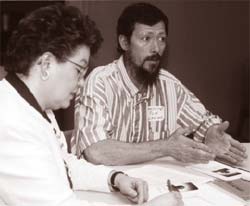
Ann Brown of Little Rock, Arkansas, and Ron Harder from Alread, Arkansas, participated in Study Circles facilitator training held in Little Rock at the Second Baptist Church.
Sometimes things happen at just the right time. In the fall of 1998, that’s exactly what happened for two Arkansas school districts. In an attempt to improve public engagement in their schools, North Little Rock School District (8,676 students in grades K—12) and Alread School District (86 students in grades K—12) decided to try something new–study circles.
Both districts participated in the Calling the Roll: Study Circles for Better Schools project, hoping to open the lines of communication between their schools and the public. In Arkansas, the project was sponsored by the Arkansas Friends for Better Schools, the Southwest Educational Development Laboratory, and the Study Circles Resource Center (SCRC).
Calling the Roll brought multiple, diverse groups of 8—12 people together to thoughtfully discuss how well public education is working in their communities. Participants agreed to attend four two-hour meetings held in schools, churches, and community centers.
North Little Rock Faces Teacher Strike
"We didn’t have much to lose by becoming involved in Calling the Roll," admits North Little Rock school board member Teresa Burl. "We wanted anything that could improve our communication, anything that could make people aware of what’s going on in schools and give us some input. We get a lot of criticism from the media that we’re not keeping the public informed."
Not only did the media attack the school board, teachers in the district criticized it as well. Tensions came to a head earlier that year, after the board voted to no longer recognize the district’s teacher union. The teachers threatened to strike.
"The perception was that we [the school board members] were tyrants and we were just rubber-stamping everything that any administrator gave us," Burl says.
Although the North Little Rock School District became involved in study circles to improve communication with the public, not to prevent a teacher walkout, Burl said the dialogue that resulted from the process allowed the crisis to be handled rationally.
"I thought the process was really open. I don’t think anyone felt they were less powerful in the study circles. There was no fear or retribution. They were free to bring up any issue," she reports.
Debbie Rozzell, a district employee who was the study circles coordinator, agrees. Parents involved in the Calling the Roll project told administrators and teachers to "get over" their petty squabbling, she reports.
"I think the communication level increased dramatically between the administration and the teachers. I don’t think the administrators understood how unhappy some of their actions were making the teachers and how dissatisfied some of the teachers were. It was good for us to hear the teachers’ point of view. But it was also good for the teachers to hear from parents and the school board."
"Study circles were an absolute godsend," Burl adds. "It helped us to avoid some things that could have been terrible, even disastrous for our school district." If a teacher strike had happened, "it would have split our community."
"Study circles were beneficial to the district, there’s no doubt about it," Smith says. "The results reaffirm that this is the way to do things."
—North Little Rock superintendent James Smith
The 115 study circles participants in North Little Rock have influenced how North Little Rock School District conducts business, says superintendent James Smith. For example, school board meetings are now televised. Also, after the study circles session, the district formed four discussion groups to further examine issues that had been identified as challenges during the study circles project. The discussion groups each included ten residents and ten school district employees, and were charged with mapping out the district’s strategic action plan. Two of the district’s three strategic planning goals for the 1999-2000 school year—increased student performance and better communication—were study circles recommendations.
"Study circles were beneficial to the district, there’s no doubt about it," Smith says. "The results reaffirm that this is the way to do things."
North Little Rock school board member Monieca West believes study circles were "extremely beneficial." She applauds Calling the Roll for involving the public in the district’s strategic planning process:
"It has certainly given the school board a checklist and guidebook to use to set policy in the future."
Alread Up in Arms
Faced with a crisis of his own, Alread school board president Ron Harder was eager to bring study circles to his community of 350 people.
In March 1998, a teacher in the district was arrested, and later convicted, of producing methamphetamines. The teacher was related to the district’s superintendent and every member of the school board but Harder. To make matters worse, the teacher’s father was on the school board.
"That was the rock bottom. The community was really up in arms," Harder observes.
The arrest came two days before Alread’s regular Saturday night board meeting. Twenty-six people showed up for the meeting, ready to pull their kids out of the district. Alread school board meetings rarely draw an audience of even one person. The board voted to suspend the teacher at the meeting.
"The tar was hot, the feathers were ready, and the rope was right outside," admits Harder.
Even though school officials had not been aware that one of their teachers was involved in drugs, the public wanted heads to roll. The superintendent tendered his resignation.
"The public perception was that the school was at fault for not knowing about the methamphetamines lab," Harder explains.
In July 1998, Judy White, Arkansas Friends for Better Schools coordinator, contacted Harder about participating in Calling the Roll. Harder jumped on the chance to start the healing process.
"I was champing at the bit, waiting for an opportunity to get involved," Harder says.
He hit the ground running, going door to door, recruiting people to serve as facilitators. His hard work paid off–17 of the 50 people that attended the statewide study circles facilitator training in Little Rock were from the small Ozark mountain town.
"That shows how dedicated they were to the process," says Arkansas Friends for Better Schools president Dan Farley. "They didn’t want to exclude anyone." Farley is also the executive director of the Arkansas School Boards Association. ASBA is now sponsoring study circles in Arkansas.
In addition to the controversy surrounding the convicted teacher, Alread had other demons to exorcise. For almost twenty years, the community has been separated on the basis of where its residents were born. In the 1970s, many outsiders, including Harder himself, migrated to Alread to enjoy its natural beauty—a movement Harder refers to as "coming back to the land." In the decades that have followed, Alread’s citizens have labeled each other as being either an Alread native or as a back-to-the-lander.
This separation led to an ongoing dispute over public access to the school gymnasium. The district had forbidden the gym to be used for any activity that was not school based, Harder said, a measure that seemed to be intended to keep back-to-the-landers from using the facility. Study circles gave the community a chance to talk about the problem and come to an agreement.
"The timing of the whole thing is that we had a nineteen-year standing disagreement over the use of school facilities by the community at large," Harder reports.
Because of the facilitated discussion provided by study circles, the school board, at its first meeting after the community’s study circles, voted 5-0 to approve a compromise achieved in the deliberative dialogue process. The public can now use the gymnasium if someone representing the school is present.
The main reason for the success of study circles and Calling the Roll in Alread is that almost a third of the community participated in the project, according to current Alread superintendent Boyce Watkins. Hired for his leadership and communication skills, Watkins says he decided to "put all his eggs into one basket" and depend on the process to get the public involved in how the school district operates.
"It not only met, but exceeded, that particular goal for the school district," declares Watkins. "I know no other combination of approaches that would have achieved more in that particular area."
As a result of study circles, Alread also made a long-needed revision of its student handbook. The district listened to the entire community, both adults and students (75 percent of Alread students in grades 9-12 participated in study circles), and used the input to rewrite a handbook Harder describes as "worse than pathetic."
"It’s now a source people can actually use," Harder says.
While the other communities across the country have used study circles, those held in North Little Rock and Alread proved to be something special, reports SCRC program director Matt Leighninger. He says, "The study circles in North Little Rock and Alread are the two most successful held on education in the country."
Both North Little Rock and Alread have been designated for the Study Circles Best Practices Project, which is looking at sixteen communities across the nation that have achieved success with study circles. The project’s final report is expected in August 2000.
Editor’s Note: Since John Pennington interviewed Harder, Harder lost his bid for reelection to the school board. However, he still leads the study circles in Alread.
John V. Pennington is communications director at the Arkansas Association of School Boards and a freelance writer.
Next Article: The Community Is the Key to Engaging Culturally and Linguistically Diverse Families