
'Date Night' Takes on a Whole New Meaning
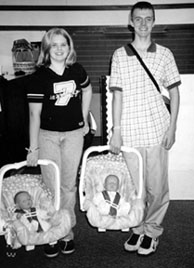
The Baby Think It Over program was started in October of 1999 as part of the 7th and 9th grade abstinence classes. These were two of the 64 students who participated this year.
In 1997, teacher Kerry Cunningham realized the teenagers at Plainview-Rover School needed something to do on the weekends besides going to "park." At the time, the K-12 school had one of the highest teen pregnancy rates in Arkansas.
Cunningham and parent Melanie Sawyer, a critical-care nurse for 23 years, developed an abstinence education program that features "Date Nite" every Friday or Saturday night—a way to engage the Plainview- Rover students in group activities that are sometimes enriching, but always fun. At the heart of the program is an abstinence curriculum for seventh and ninth graders. It also includes assemblies presenting a variety of speakers from health department representatives to unwed mothers and a variety of special events.
Since the program began, Cunningham has moved away from Plainview, but Sawyer is still active and dedicated to making life better for the students in this working-class community of 750. In fact, she has become the director of the 21st Century Community Learning Center in the school district—one of more than 3,600 nationwide funded through the U.S. Department of Education's 21st Century Community Learning Centers program.
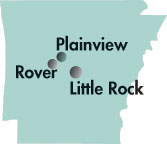
On Date Nites, students in grades 7-12 from Plainview-Rover, or any other school in the county, are invited to spend the evening doing something fun, such as going bowling in a town 30 miles away, or attending a dance, or participating in a fun night in the school gym. A fun night may involve playing basketball, board games, or table tennis and watching videos. Students are always given dinner. Occasionally the group will do something special such as go to the IMAX Theatre in Little Rock, 69 miles away. The school pays for the activities, but Date Nite participants are required to bring five dollars to pay for their meals. There is a special fund for students who can't afford to pay.
 | |
Date Nite provides a constant source of adult friendship in the lives of students who are often left alone or who don't feel they can talk to their parents openly about sex and other sensitive topics. There is a core group of 12 adults—teachers and parents—who chaperone, drive the students to activities when Date Nite is held off campus, and if needed, take the kids home after the program is over. Sawyer says, "We are really open with the kids—we try to be there for them. We are like the parents many of them don't have around." She reports that students frequently express their appreciation to the adults involved in the program.
Sawyer has seen an improvement in behavior, including a reduction in substance abuse and petty crime, since Date Nite has begun. She notes that students who used to be "troublemakers" now never miss Date Nite and the chance to socialize with the other 30-50 students who attend.
School staff members try to stay on message about abstinence but Sawyer says, "you can't do it every single day, day in and day out, or the students won't pay attention to you." However, through activities that are both entertaining and meaningful, combined with the abstinence curriculum, the team at Plainview-Rover School are getting the message across. Some of the more innovative activities include the "Rocking Teen Pregnancy Away" rockathon where students rocked in rocking chairs from eight in the morning until six in the evening to raise money and awareness, and "Messages from the Heart," a scavenger hunt for 25 abstinence and drug-free messages.
The abstinence curriculum includes a frank discussion of the facts of life with students. One of the coaches instructs the boys, and Sawyer the girls. It also includes the "Baby Think It Over" program with computerized dolls that simulate a real baby. The students must take care of the babies programmed to need changing, feeding, and burping. Sawyer reports the students are always excited to get their babies, but when they return them, their comments are "You can have this baby back!" or "I'm not ready for this!"
Sawyer is enthusiastic about the school's abstinence program which has helped reduce the pregnancy rate from five or six a year (among approximately150 high school students) to one this past year. This is the first time in many years there have been no pregnancies in the graduating class. The one pregnancy involved a student who had not attended the ninth-grade abstinence class and had not participated in Date Nite activities. "I think that would have a made a difference," says Sawyer.
After-School Program Meets Other Student Needs
Just as the Date Nite program provides a safety net for students who might engage in risky behaviors on the weekends, Plainview-Rover's after-school program supports the many latchkey children in the district who can easily become involved in high-risk behaviors each afternoon. The 21st Century Community Learning Center program features an educa-tional activity each day, tutoring, access to computers and the school library, and a variety of enrichment activities. Students who aren't doing well academically are especially encouraged to attend the program so they can receive additional help.
 | 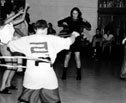 | 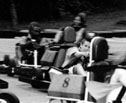 |  |
| Wild River Country in Little Rock The students raised money to go on this trip. | Back to School Dance Teens are in the middle of a hula hoop contest. | Gator Park in Little Rock | Bowling in Russellville Bowling night attended by 36 participants including six adults. |
To foster participation in the program, the district is trying to eliminate barriers to attendance. Because transportation is definitely an issue in this community, where most parents commute to jobs in the lumber and poultry industries in neigh-boring cities and towns, the district is now working with businesses in the region to establish safe drop-off areas. If the drop-off areas become a reality, parents could pick their children up in the evenings from these scattered locations instead of driving to the school "That way parents may only have to drive a mile or so to pick up their children after school," explains Sawyer.
Sawyer has worked hard to get such enrichment activities as Tae Kwan Do and the 4-H Club in place for after-school participants. Currently she is looking for someone to give dance lessons to the students, and she is continually trying to drum up financial support from area businesses. The students often raise money for special activities by holding such fundraisers as car washes.

Field trips, such as a recent visit to Heifer Project International, are part of Plainview-Rover's after-school program.
A recent overnight field trip was to Perryville, Arkansas, to visit Heifer Project International. The organization provides livestock to families in underdeveloped countries and offers educational opportunities, too. The field trip simulated a global village where students were assigned to a pretend village, set up just as a village would be in an underdeveloped country. In the Plainview-Rover group, there were 20 students and chaperones. The group was given only two and a half gallons of water and had to make decisions about the way they would live for a day, given limited resources. Sawyer reports the students had to use problem-solving, math, and social skills to get the food and firewood they needed for the day through bartering and resource allocation. Her after-school program students were so enthusiastic, they want to return for a one-week camp this summer.
In a district that is struggling to get parents involved in their children's education, the after-school program is also a way to get parents into the school. Parents are required to attend three out of five parent meetings for the after-school program in order for their children to remain in the program.
For the Plainview-Rover School staff, creating a safe, educational, and supportive environment is key, says Sawyer, "because many of our students don't have that at home."
Next Article: Service Learning Sparks Community and Student Achievement in Balmorhea