E-Mentoring for Math and Science Teachers
Inquiring minds want to know: "What are some good resources for teaching data analysis and statistics that are relevant to primary grade students?" "How does hydroponic gardening work?" "How can I assess students' scientific knowledge through games?" "What is the difference between binary and trinary numbers? How do I best teach that difference?" These are some of the questions received from math and science teachers, submitted through a telementoring project sponsored by SEDL's Eisenhower Southwest Consortium for the Improvement of Mathematics and Science Teaching (SCIMAST) program.
 Officially called the Online Mentoring Project for Mathematics and Science Teachers, the effort got its start in the fall of 1999. That's when SEDL program specialist Phillip Eaglin, who works in the SCIMAST program, met with New Mexico teachers who had received the Presidential Award for Excellence in Mathematics and Science Teaching. The awardees wanted to make a contribution to math and science education beyond their own teaching and decided the best way to do so would be by mentoring other teachers, especially new teachers.
It was suggested that an electronic mentoring project might be a good way to begin. The New Mexico Presidential Awardees acknowledged that most schools had computers and Internet access that likely were being underutilized, and with electronic mentoring large numbers of science and math teachers could access such a program.
After several months of planning, the SCIMAST team and SEDL's Web administrator firmed up plans for a moderated telementoring program. SEDL invited teachers in Arkansas, Louisiana, New Mexico, Oklahoma, and Texas who had received the Presidential Award for Excellence to be mentors. Nineteen Presidential Awardees, who are named on the mentoring Web page, agreed to participate and submitted information about their areas of expertise, which SEDL staff entered into a database.
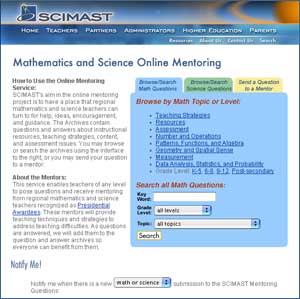
Teachers who visit the mentoring Web page may submit questions related to teaching math and science or questions about the ways their students are learning math and science. When questions are submitted online, the subject, specialty area, and grade level are simultaneously matched to the mentor teachers' background and expertise. When the questions received relate to issues such as state standards and assessments, the database matches questions to mentors according to the state in which they teach. Three mentors receive each question; when they return their answers, the responses are compiled into a single answer by a SCIMAST team member, who might also contribute to the answer posted online.
The mentoring project differs from an "ask an expert" or virtual reference desk service in that the responses can result in further discussion or raise additional questions. Also, the questions are often not the sort that can be answered quickly - they can pose challenges for the mentors and SCIMAST team as well as for the math and science teachers seeking help.
In answering other teachers' questions, the mentors try to encourage the teachers to closely observe their students, expand teaching strategies, and reflect on their practice. Eaglin says "Encouraging reflection is probably most critical. We want to assist teachers in looking back to discover what did and did not work in their classrooms. By supporting and encouraging reflection, the mentors can help other teachers learn and grow professionally."
Eaglin notes that the service is not limited to novice teachers seeking assistance. "Even an experienced educator needs to ask questions now and then," he says.
The SCIMAST mentoring project may be found at http://www.sedl.org/scimast/archives/ (Site no longer available 12/2005). Visitors to the site may pose a question, browse through previously submitted questions and answers that are sorted by topic, or sign up to receive email notification of new archive submissions.
Next Article: A Click Away - Online Resources for Recruitment, Retention, and Quality Issues